The Graveyard of Working Products
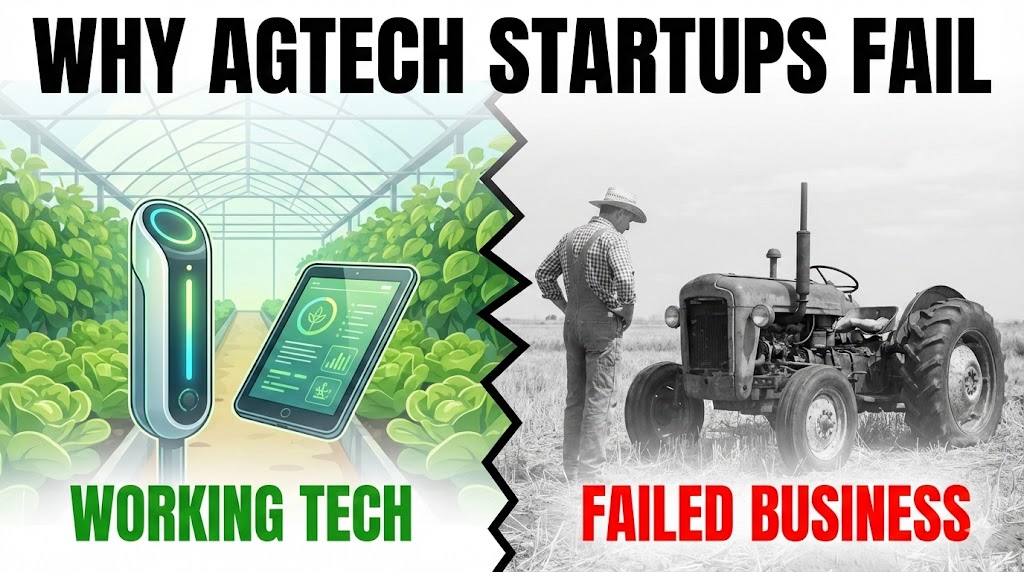
Walk through any AgTech conference and you'll find a graveyard of products that worked. Precision irrigation controllers that accurately monitored soil moisture. Crop disease detection systems that caught infections three days before they were visible to the eye. Yield forecasting tools that outperformed farmer intuition in controlled trials.
And yet — adoption stalled. Revenue never materialized. The companies are gone.
What went wrong is worth understanding carefully, because the failure modes of AgTech are not random. They cluster around a few structural patterns that repeat across geographies and product categories.
False Signals from Early Conversations
The first trap is the most common: mistaking polite interest for genuine demand.
Farmers are, broadly speaking, courteous people. When a founder shows up with a prototype and asks "what do you think?", they tend to get encouraging answers. Farmers will say things are interesting, that they can see the value, that they'd love to try it out. Founders interpret this as validation.
"Founders often interpret farmers' polite interest in prototypes as real market demand."
It isn't. Casual acknowledgment during a product demonstration does not reliably indicate purchasing intent. The gap between "that's neat" and "I'll write you a check" is enormous in agriculture — and it's a gap that has consumed enormous amounts of venture capital.
Misleading Customer Feedback
The problem compounds itself. Having received positive verbal responses, founders continue developing the product based on those stated opinions rather than observed behavior. They build features that farmers said they wanted. They optimize metrics that farmers said they cared about.
But when it comes time to actually pay for the product — especially during the crunch of planting or harvest season when cash flow is tight and attention is elsewhere — the enthusiasm evaporates. Companies discover that what farmers say in February has limited predictive value for what they'll buy in May.
The only reliable signal is demonstrated willingness to pay, under realistic conditions, at a realistic price point. Everything else is noise.
Design That Doesn't Match Daily Reality
The second major failure mode is the workflow mismatch. A product can solve a real problem but still fail to achieve adoption if it disrupts the way work already gets done.
Agriculture is highly routinized. Farmers develop operational patterns that let them manage enormous complexity — a modern farm involves hundreds of interlocking decisions daily across soil, weather, equipment, labor, and markets. Those patterns are finely tuned. A new tool that adds steps, requires new habits, or slows down any part of the workflow faces extraordinary adoption headwinds, regardless of its technical merits.
A tool that slows down work or complicates the process — even if technically impressive — won't get used. Integration into existing workflow is not a nice-to-have; it's a prerequisite.
The products that succeed in agriculture tend to be invisible — they slot into existing processes and make them slightly better, rather than demanding a new process be learned. This is a harder design challenge than it sounds.
Business Model Mistakes
The third structural failure is pricing and payment timing. Many AgTech companies arrive with business models designed for software buyers — subscription fees, monthly payments, seat licenses — that are fundamentally misaligned with agricultural economics.
Farmers receive the overwhelming majority of their annual income at harvest. They pay for inputs (seeds, fertilizers, equipment) on credit, with payment due after the crop is sold. A software product that demands monthly subscription payments is asking a farmer to pay from cash they don't yet have.
- Upfront SaaS pricing creates cash-flow barriers for smaller operations
- Annual payment structures timed to harvest work significantly better
- Revenue-share models aligned with outcomes see the highest adoption
- Seasonal free trials during critical decision-making periods build real adoption
The companies that have navigated this successfully tend to have thought carefully about when farmers actually have money, and structured their pricing accordingly.
Distribution: The Hardest Problem
Even with the right product, the right design, and the right pricing, the distribution challenge remains formidable. Agriculture is a relationship-driven industry. Farmers buy from people they know and trust — local dealers, agronomists, cooperatives, and neighbors who've used the product and can vouch for it.
A direct-to-farmer sales model run by a team of engineers with no agricultural relationships is an expensive and slow path. The startups that have scaled have typically done so through established distribution channels — agronomic service providers, input retailers, farm management consultancies — rather than trying to build farmer relationships from scratch.
What This Means for AI SENSE
We think about these failure modes constantly. Building technology for agriculture requires holding two things simultaneously in mind: the technical problem (which is hard) and the adoption problem (which is equally hard and frequently neglected).
Our approach is to validate genuine value before building, to comprehend actual purchasing patterns before pricing, and to design solutions that fit into existing workflows before asking farmers to change theirs. We're building technology for the long term — which means building it to actually be used.