The Problem: Monitoring Farm Entry Without Surveillance
Farms in Maryland — and across the country — face a persistent tension: they need to know who is coming and going, especially at irregular hours, but continuous video surveillance creates a surveillance environment that erodes trust and raises legitimate privacy concerns for workers and visitors alike.
The question PoseGuard was built to answer is deceptively simple: can a system tell the difference between expected daytime activity and suspicious after-hours intrusions without ever recording, storing, or transmitting identifiable imagery of the people it observes?
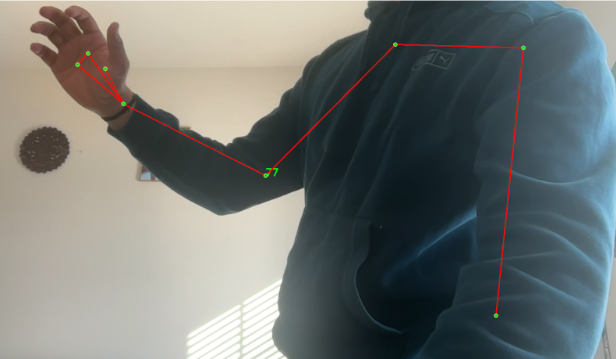
PoseGuard reduces every person to an anonymous skeletal stick-figure. No face. No identity. No video. Just movement.
A Privacy-First Approach
The key insight behind PoseGuard is that security does not require identity. Most of what a security system needs to know — is someone present? Are they behaving unusually? Are they in a restricted area? — can be answered entirely from body position and movement without any face or identifying detail.
PoseGuard works by running a real-time pose estimation model that reduces each person in frame to a skeletal representation: a set of joint positions and their relationships. The actual pixel data — skin tone, clothing, face — is never stored and never transmitted. The skeleton is what persists.
Built for Real-World Farm Conditions
Laboratory-tested systems often struggle in the field. PoseGuard was designed from the start for the constraints of real farming environments: variable lighting from dawn to dusk, outdoor distances, partial occlusions from equipment and vegetation, and — critically — the absence of reliable internet connectivity.
The system runs on low-power edge hardware (Raspberry Pi class devices) and incorporates privacy standards like GDPR from the ground up. It doesn't require a cloud connection to function. All inference, all decision-making, all alerting happens locally.
Rethinking Pose Estimation for the Farm
Off-the-shelf pose estimation models are optimized for well-lit, close-range, controlled environments. Adapting them to farm security meant simplifying models to run efficiently on constrained hardware and tuning processing frequency to balance responsiveness with power consumption.
It also meant reconsidering what "good enough" looks like. A security system doesn't need perfect skeleton reconstruction — it needs reliable detection of presence and reliable identification of anomalous postures. Those are different problems with different solutions.
From Movement to Meaningful Alerts
Once the system has a skeletal representation, it needs to decide: is this behavior normal? PoseGuard identifies a set of suspicious posture signatures — crouching low behind equipment, postures consistent with fence climbing, extended stationary presence in restricted zones — and generates alerts when these patterns are detected.
Critically, the system generates alerts about behavior, not about people. The alert says "unusual posture detected at the north gate at 02:14" — not "this person was observed."
Translating Human Intuition Into Logic
One of the most interesting engineering challenges was formalizing what counts as "suspicious." Human intuition is easy: you know when something looks wrong. Translating that into skeletal joint angle thresholds and velocity profiles is harder than it sounds.
The team spent significant time working with farm operators to map their intuitions about normal versus suspicious behavior onto the quantitative features available from skeleton data — joint angles, limb velocities, torso orientation, and proximity patterns relative to defined zones.
Trust Built on Privacy
The most important outcome of the PoseGuard project isn't the technical performance metrics — it's the response from farm workers themselves. Systems they know cannot identify them are systems they accept. Security without surveillance anxiety is not just a privacy ideal; it's a practical requirement for adoption on working farms where worker trust directly affects operations.
Looking Ahead
The next development phase for PoseGuard includes exploring alternative alerting mechanisms beyond the current push notification model, integrating with existing farm management software, and investigating whether the same privacy-preserving approach can be extended to broader industrial security contexts beyond agriculture.
The core philosophy — that security and privacy are co-requirements, not trade-offs — will remain the foundation of everything we build on top of this work.